

Growing a business in Denton, TX means your technology stack has to keep pace with new hires, new locations, and new security expectations. Many companies start with break-fix IT, then realize that reactive support costs more in downtime than proactive management would have cost in monthly fees.
For businesses comparing IT support in Frisco, Plano, and the broader North Texas region, the decision usually comes down to scope, pricing model, and whether the provider can scale with you. This guide explains what managed IT services typically include, how local pricing is structured, and what to look for when your internal IT is no longer enough.
Key Takeaways
- The Denton Chamber of Commerce IT Services directory currently lists eight provider results, indicating an active local market for business technology support.
- Modern managed IT packages increasingly include managed endpoint detection and response (EDR), managed SIEM, email security, backup and disaster recovery, and cloud productivity support rather than legacy antivirus alone.
- Flat per-user pricing replaces unpredictable hourly billing, letting finance teams budget accurately instead of absorbing surprise repair costs.
When Break-Fix Support Stops Working for Growing Companies
A three-person office can often survive on ad-hoc IT help. Once you cross ten employees, add a second location, or start handling regulated client data, the math changes.
Every hour of downtime affects more people, and the security surface area expands faster than most owners track.
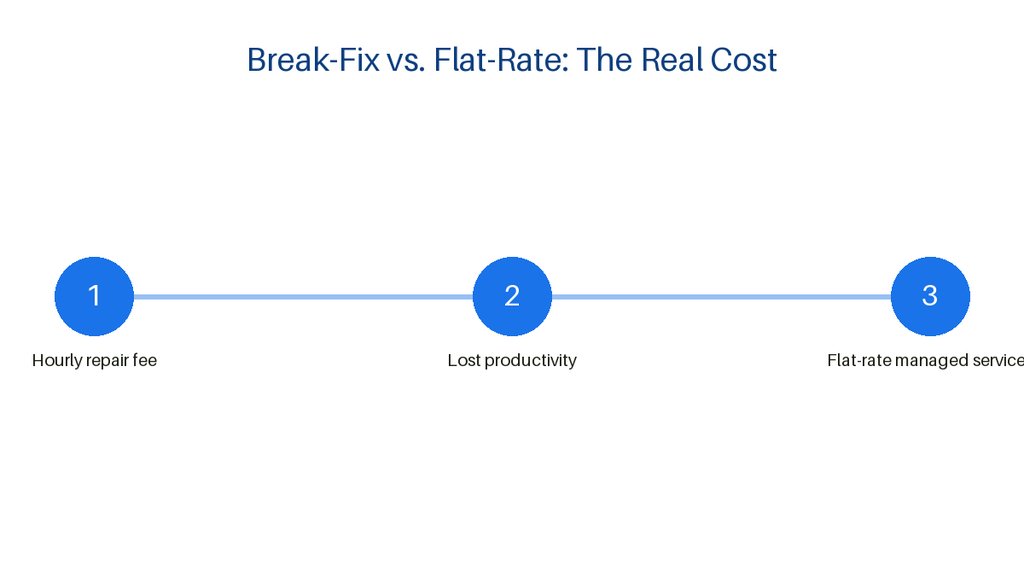
Reactive support also hides costs. An hourly repair seems cheap until you add the lost productivity of four staff members waiting three hours for email to come back online.
Flat-rate managed services convert that uncertainty into a predictable operating expense.
Denton Area Managed IT Service Indicators
Pricing reflects a single advertised rate from one Denton-area provider, not a market-wide standard. Provider count reflects directory listings as of September 2026.
What Managed IT Services Typically Cover
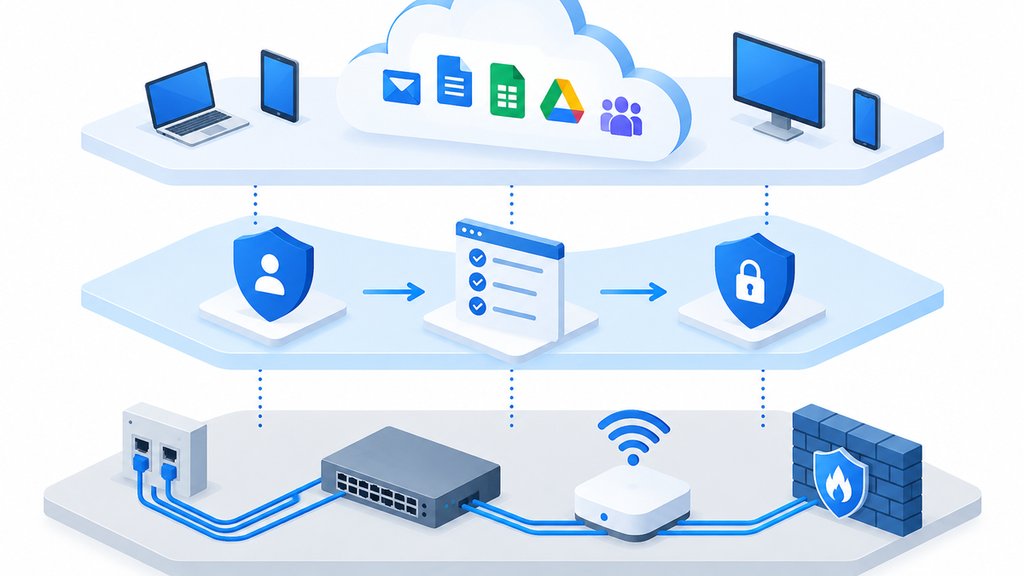
Managed IT providers generally bundle monitoring, help desk, security tools, and strategic planning into a per-user or per-device monthly fee. The exact stack varies, but most Denton-area providers emphasize several core layers.
Endpoint protection has moved beyond traditional antivirus toward managed endpoint detection and response, which monitors behavior and anomalies rather than relying solely on known threat signatures. Centralized security monitoring through managed SIEM collects and correlates logs across your environment for faster threat identification.
Local Provider Landscape and Pricing Signals
The Denton Chamber of Commerce IT Services directory currently shows eight provider results (2026), reflecting an active local market with multiple options for business technology support. This density matters because competition tends to drive faster response times and more transparent pricing.
Security Layers Beyond the Desktop
Email protection for Microsoft 365 or Google Workspace environments has become a standard conversation topic during managed IT sales processes. These services typically include filtering, encryption, and identity-focused protections that reduce the risk of credential compromise and business email compromise schemes.
Backup and disaster recovery capabilities are commonly discussed by North Texas managed IT providers serving the Denton market. The emphasis usually covers not just file restoration but full business continuity planning, including recovery time objectives and recovery point objectives tailored to each client’s operational tolerance.
Cloud Productivity and Infrastructure Management
Microsoft 365 and similar cloud productivity platforms require ongoing administration that many small businesses underestimate. User provisioning, license optimization, conditional access policies, and data loss prevention rules all need regular attention as staff change and compliance requirements evolve.
Network infrastructure, including structured cabling, switching, secure Wi-Fi, and firewall configuration, forms the physical foundation that cloud services depend on. Providers with in-house cabling and network design capabilities can deliver more cohesive outcomes than those who subcontract every physical layer.
How The Local Circuit Supports Denton and Frisco Area Businesses
The Local Circuit is a Denton, TX-based managed service provider that has worked alongside small businesses for over 15 years, offering on-site, remote, and in-house support across Denton, Frisco, Plano, Carrollton, Aubrey, Lewisville, Decatur, Sanger, Prosper, Ponder, Gainesville, Whitesboro, and McKinney. The team handles physical hardware management, help desk support, network security, and cloud productivity services such as Office 365.
The company operates on flat per-user pricing with simple month-to-month agreements and no long-term contracts. Every network project includes clear documentation handed over at close, and ongoing managed support remains available after installation so the same technicians who built the environment also monitor and maintain it.
The Local Circuit is CJIS Certified, an InfraGard Member, and Aggie Owned and Operated.
Scaling IT Decisions Alongside Employee Growth
Adding ten employees in six months strains ad-hoc IT approaches. A five-person company can survive on break-fix relationships, but twenty-five people create coordination complexity that demands proactive systems.
Device provisioning becomes a bottleneck without standardized processes. Each new hire needs a laptop, email access, security permissions, and application licenses configured before their first day.
Password management and offboarding procedures grow critical as headcount rises. Former employees retaining access to cloud accounts represent one of the most common security oversights in expanding businesses.
Network infrastructure must evolve to handle increased simultaneous users. A wireless router adequate for eight people buckles under forty devices competing for bandwidth during video conferences.
Software licensing compliance becomes harder to track informally. Shadow IT proliferates when departments independently adopt tools without central oversight or negotiated volume pricing.
Help desk response expectations shift dramatically with scale. Executives who once texted a single technician now need ticket systems with defined priority levels and resolution timeframes.
Documented policies replace verbal norms as the organizational memory spreads across multiple managers. Consistent onboarding checklists and acceptable use agreements reduce friction and legal exposure.
Remote and Hybrid Work Infrastructure Demands
The shift toward distributed teams has permanently altered IT support requirements for Frisco and Denton businesses. Employees working from home two or three days weekly need secure, reliable access indistinguishable from the office experience.
Virtual private networks and zero-trust architectures have replaced simple perimeter-based security models. Every connection endpoint must authenticate independently rather than inheriting trust from a physical location.
Home internet quality varies enormously and falls outside employer control. IT support must troubleshoot connectivity issues across dozens of residential ISPs and router configurations.
Collaboration platforms require intentional governance to prevent information fragmentation. Without administrative oversight, teams create redundant channels, lose documents in personal storage, and fragment institutional knowledge.
Endpoint management tools enable remote patching, monitoring, and troubleshooting without desk visits. These capabilities proved essential during recent years and remain standard expectations for modern managed IT services.
Video conferencing hardware in conference rooms demands integration with platforms employees use from home. Hybrid meetings fail when in-office participants cannot share screens or hear remote attendees clearly.
Print and scan workflows complicate significantly when employees split time between locations. Secure cloud printing solutions allow document release at any office location while maintaining audit trails for sensitive materials.

Industry-Specific Compliance Considerations
Healthcare practices near Denton’s medical district face HIPAA requirements that shape every IT decision. Business associates agreements with technology vendors, encrypted communication channels, and access logging become non-negotiable elements.
Financial services firms in Frisco’s growing commercial corridors encounter SEC and FINRA oversight. Email archiving, trade surveillance integration, and immutable audit logs require specialized infrastructure planning.
Manufacturing and logistics operations around both cities handle supplier data subject to contractual confidentiality terms. IT support must segment networks so production systems remain isolated from general business traffic.
Professional services firms managing client matter information need ethical wall capabilities. Lawyers and accountants must demonstrate that confidential data remains inaccessible to personnel without specific engagement clearance.
Educational institutions and training companies process student records under FERPA protections. Cloud storage locations, third-party application integrations, and parent portal access controls all trigger compliance review obligations.
Retail businesses collecting payment card data navigate PCI-DSS validation requirements. Network segmentation, vulnerability scanning, and strict access controls around cardholder data environments demand ongoing technical attention.
Even businesses without explicit regulatory mandates increasingly encounter customer security questionnaires. Prospective enterprise clients assess vendor IT practices before contract execution, making robust infrastructure a competitive differentiator.

Strategic Technology Planning for Leadership Teams
Technology decisions increasingly belong in boardroom conversations rather than backroom maintenance. Forward-looking businesses align IT roadmaps with three-to-five-year operational objectives rather than reacting to immediate failures.
Before kicking off any major technology initiative, businesses should understand what goes into IT Project Management In Denton to avoid scope creep and budget surprises.
Capital expenditure versus operational expenditure analysis affects cloud migration timing and hardware refresh cycles. Managed IT providers help model total cost of ownership scenarios that account for hidden infrastructure burdens.
Cyber insurance underwriting requirements have tightened considerably, demanding documented security controls. Organizations without multi-factor authentication, endpoint detection, and incident response plans face coverage exclusions or premium increases.
Talent acquisition and retention connect directly to technology experience. Prospective employees evaluate whether prospective employers offer modern collaboration tools, reliable systems, and flexible device policies.
Merger and acquisition activity in the Frisco and Denton markets creates IT integration complexities. Due diligence processes must assess target company infrastructure, licensing compliance, and technical debt before valuation finalization.
Sustainability considerations now influence hardware selection and data center choices. Energy-efficient equipment, responsiblee-waste disposal, and cloud provider renewable energy commitments align with evolving stakeholder expectations.
Regular technology business reviews with managed IT partners transform support relationships into strategic advantages. Quarterly assessments of ticket trends, security posture, and capability gaps inform proactive investments rather than emergency spending.
Frequently Asked Questions
What does managed IT support typically cost in the Denton area?
This rate typically includes monitoring, security, help desk, and strategic planning.
How many IT support providers operate in Denton?
The Denton Chamber of Commerce IT Services directory currently lists eight provider results. This active market gives businesses multiple options to evaluate for fit, expertise, and pricing model.
What security tools should a managed IT package include?
Modern managed IT offerings increasingly include managed endpoint detection and response, managed SIEM for centralized logging and correlation, and email security for Microsoft 365 or Google Workspace environments. These layers provide deeper visibility than legacy antivirus alone.
Is backup and disaster recovery part of standard managed IT services?
North Texas managed IT providers commonly discuss backup, recovery, and business continuity as part of their service scope. The specific terms, including recovery time and recovery point objectives, should be documented in any service agreement.
What is the advantage of flat per-user pricing over hourly IT support?
Flat per-user pricing converts unpredictable repair costs into a fixed monthly operating expense. This helps finance teams budget accurately and eliminates surprise bills after major incidents or complex troubleshooting sessions.
Does The Local Circuit require long-term contracts for managed IT services?
The Local Circuit offers simple month-to-month agreements with no long-term contract required.

About the author
Matt Forman - Owner & Chief Techie
Matt Forman is the Owner and Chief Techie at Local Circuit, a Denton, Texas-based managed service provider he leads in delivering small-business technology management and security. For over 15 years, his team has worked alongside small businesses, local municipalities, law firms, and first-responder agencies as their trusted IT partner.