
If you run a business in Dallas, Plano, Frisco, or anywhere across North Texas, you have probably already been scanned by an attacker this week. Automated tooling sweeps Texas IP ranges constantly, looking for an unpatched VPN gateway, an exposed RDP port, or a forgotten cloud storage bucket that opens a door into your network.
A network vulnerability assessment is the controlled, defender’s version of that same exercise, but performed by people on your side and aimed at remediation rather than extortion. This guide walks through what a real assessment looks like for a Dallas business, what it costs you to skip one, and how to choose a Texas partner who delivers findings you can actually fix.
Key Takeaways
- A network vulnerability assessment systematically scans firewalls, endpoints, cloud resources, wireless, and user behavior, then classifies findings as critical, high, medium, or low so your team can prioritize remediation that actually reduces risk.
- Texas businesses must report any breach affecting 250 or more residents to the Attorney General within 30 days, which makes proactive testing far cheaper than reactive disclosure, credit monitoring, and civil penalties.
- Vulnerability scanning and penetration testing are different tools: scanning catalogs the open doors, penetration testing proves whether an attacker can actually walk through them to reach domain admin or sensitive data.
- For most Dallas SMBs, quarterly external scans, monthly internal scans, and an annual penetration test is the minimum cadence that satisfies cyber insurance, HIPAA, PCI DSS, and ISO 27001 expectations.
What a Network Vulnerability Assessment Actually Includes
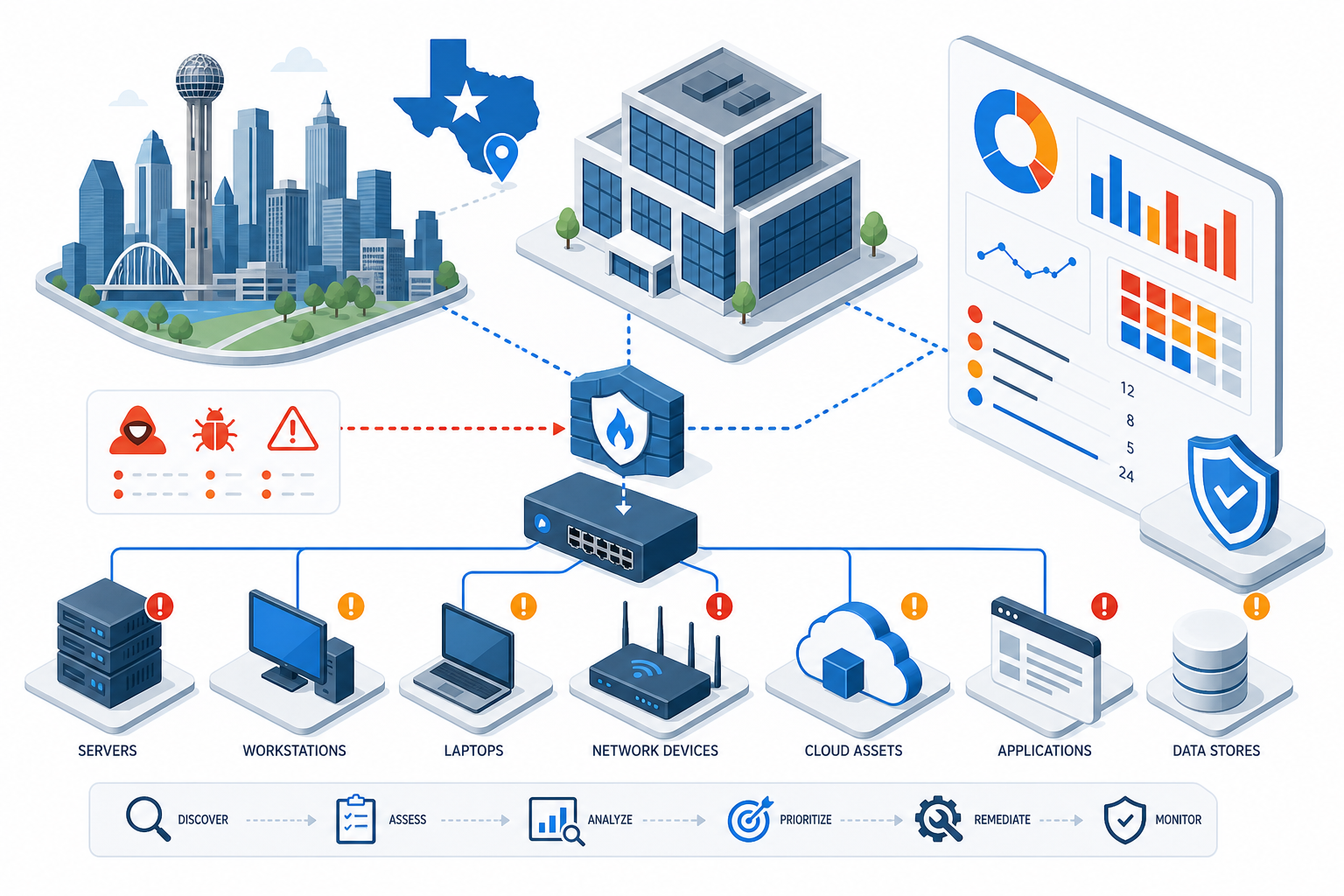
A network vulnerability assessment is a systematic examination of your infrastructure that identifies, classifies, and prioritizes weaknesses before an attacker can find them. It combines automated scanning, manual configuration review, and a human analyst who interprets the noise and tells you what actually matters in your environment.
The scope typically covers external IP space, internal networks, firewalls, switches, servers, endpoints, wireless access points, VPN gateways, and increasingly your Microsoft 365 and cloud tenant configuration. A thorough assessor also reviews your network diagram, asset inventory, patching cadence, and identity provider so the findings align with how your environment actually runs.
Each finding is rated critical, high, medium, or low so your team can sequence remediation work in a sane order. A report that just dumps a few thousand raw CVE numbers without that triage is a scan, not an assessment, and it is not going to move the needle on real risk.
The deliverable should include compensating controls and concrete, step by step fix guidance for every critical and high finding. If your provider says patch the server without telling you which patch, which server, and what to test afterward, you bought a checklist product, not a real assessment.
Texas Network Vulnerability and Breach Snapshot
Sources: Texas Office of the Attorney General data breach disclosures, Verizon 2025 DBIR, IBM Cost of a Data Breach 2024, NIST SP 800-53 and SP 800-115, CIS Controls v8, PCI DSS v4.0, Packetlabs and Vectra industry research.
The Dallas Threat Landscape: Why Texas Businesses Are Squarely in the Crosshairs
Dallas-Fort Worth is the fourth largest metro in the United States, home to dense clusters of healthcare, financial services, energy, manufacturing, and professional services firms. That concentration makes North Texas a prime hunting ground for ransomware operators, credential stuffing campaigns, and business email compromise crews.
The Texas Attorney General publishes ongoing breach reports under the Identity Theft Enforcement and Protection Act. Recent disclosures include a Dallas County ransomware event that exposed personal data on more than 200,000 people and a Conduent breach that the Attorney General publicly described as likely the largest breach in U.S. history, affecting roughly 4 million Texan
s.
Smaller companies feel this pressure even more sharply than the headlines suggest. Verizon’s 2025 DBIR found that SMBs experienced approximately four times more confirmed breaches than large organizations in 2024, and 88 percent of those SMB breaches involved ransomware compared with 39 percent at large enterprises.
The window between a new vulnerability being disclosed and an attacker weaponizing it has collapsed dramatically. Recent research puts that gap at roughly 14 days on average, down from 68 days, with 28 percent of exploits landing within 24 hours of disclosure.
Vulnerability Assessment vs. Penetration Testing: Different Tools, Different Answers
Vulnerability scanning is breadth: it looks across every reachable system and lists what could be exploited based on signatures, version numbers, and configuration patterns. Penetration testing is depth, since a human tester takes those findings and proves whether an attacker can actually use them to reach domain admin, exfiltrate data, or pivot from the office network into your cloud tenant.
NIST Special Publication 800-115 treats the two as complementary techniques, noting that penetration testing usually relies on performing both network port and service identification and vulnerability scanning to identify hosts and services that may be targets. Most mature programs run automated scans monthly or weekly, layered with a full scope penetration test once a year or whenever a significant change to the environment ships.
The reason to pair them is straightforward. A scanner will flag a high finding that is actually unreachable behind a properly segmented firewall, and it will quietly miss a business logic flaw or a chained misconfiguration that a real tester would walk straight through.
For Dallas businesses approaching a cyber insurance renewal, both artifacts increasingly appear on the carrier application. Underwriters want to see your scan cadence, your most recent penetration test report, and proof of remediation before they price the policy or, in some segments, agree to write coverage at all.

Compliance Pressure: HIPAA, PCI DSS, ISO 27001, and Texas Notification Law
Regulated data drives most of the urgency around vulnerability assessments. PCI DSS is the most strict in its requirements regarding network vulnerability scanning, with quarterly external and internal scans required to be performed by qualified personnel and external scans conducted by an Approved Scanning Vendor.
HIPAA does not require a specific vulnerability scan frequency, but it places heavy emphasis on a detailed assessment of vulnerabilities and potential risks affecting protected health information. In practice, that means an annual assessment at minimum, with rescans after any major infrastructure or application change.
ISO 27001 recommends performing both external and internal vulnerability scans on a quarterly basis as part of your information security management system. NIST guidance defined in SP 800-53 and SP 800-171 calls for monthly scans for systems handling controlled unclassified information, while CIS Controls v8 recommends automated scans at least weekly across all systems, with frequency adjusted based on risk.
Texas adds its own layer on top of every federal framework. State law requires businesses that experience a data breach affecting 250 or more Texans to report it to the Office of the Attorney General within 30 days, and the Attorney General is authorized to obtain civil penalties of at least $2,000 but not more than $50,000 per violation, with additional penalties of up to $250,000 per breach for failing to take reasonable action to provide notice to consumers.
How Often Should a Dallas Business Run an Assessment?
Most cybersecurity frameworks land in the same general place: continuous or near-continuous scanning for critical assets, monthly scans for internal systems, and quarterly assessments at a minimum across the full environment. PCI DSS v4.0 mandates quarterly as a minimum and CIS Controls v8 recommends weekly scanning for critical assets, with frequency turned up for anything internet facing or housing sensitive data.
The right cadence for your business depends on three factors: how much your environment changes, how sensitive the data is, and what your insurer or auditor expects to see documented. A 25 person professional services firm in Uptown with a stable network can usually run quarterly external scans, monthly internal scans, and one annual penetration test.
A healthcare practice in Plano or a fintech with weekly deployments in Frisco needs to scan substantially more often. Compliance-driven scans should also be triggered by any major infrastructure change, as it is common practice to conduct vulnerability scans on parts of the infrastructure that have undergone a major change to ensure the security of newly modified systems.
Whatever cadence you settle on, write it down and stick to it. An undocumented schedule is not a program, and auditors, insurance carriers, and your own board will all eventually ask to see the policy in writing along with the evidence that you followed it.
What a Quality Assessment Report Should Contain
A useful report is more than a vulnerability list with red and yellow icons. It opens with an executive summary a non-technical owner can read in five minutes, then drills into prioritized findings, supporting evidence, and concrete remediation steps for each issue.
Every critical and high finding should include the affected asset, the CVE or configuration error, the business impact in plain English, and the recommended fix with verification steps. If your report shows a high with no asset name and no fix path, push back on the provider, because that is busy work, not security work.
The report should also include a dedicated wireless and remote access section. A real wireless test verifies the segregation between corporate Wi-Fi and guest Wi-Fi, evaluates the corporate wireless configuration, and checks the security of your VPN, multi-factor authentication, and any always-on remote access tooling.
Finally, expect a retest as part of the engagement. After your team remediates the criticals and highs, your assessor should validate the fixes and update the report so the closed findings are documented with evidence rather than just claimed in an email.
Common Findings We See in Dallas Networks
Across hundreds of assessments, the same handful of issues account for the bulk of critical and high findings. Unpatched VPN gateways, default credentials on network appliances, and overly permissive Active Directory groups appear in nearly every engagement we run across the Metroplex.
Wireless misconfiguration is a close second. Corporate SSIDs that drop guest devices onto the same VLAN as the file server, or guest networks with no client isolation, show up in roughly one of every three assessments we deliver in Dallas County.
Cloud is where the newest gaps live. Misconfigured Microsoft 365 mailboxes, publicly exposed S3 or Azure storage buckets, and OAuth tokens granted to long-forgotten third party apps are the modern equivalent of an open RDP port left running on the internet for years.
Endpoint posture rounds out the list. In 76 percent of intrusion cases, threat actors employed one or more of 10 specific vulnerabilities, all of which were previously known and contained a patch at the time of exploitation, which is why stale admin accounts, missing EDR coverage, and out of date Windows builds remain the quiet preconditions for nearly every ransomware case.
Frequently Asked Questions
How much does a network vulnerability assessment cost for a Dallas business?
For a typical Dallas SMB with 20 to 100 endpoints, a one-time external and internal vulnerability assessment usually runs between $2,500 and $10,000 depending on scope, while a managed program with monthly scans and an annual penetration test typically lands in the $8,000 to $25,000 range per year. Cost rises with the number of public IPs, cloud tenants, physical locations, and any specialized scope such as web applications or PCI cardholder environments.
How long does an assessment take from kickoff to final report?
For most small and mid-sized environments, the active scanning and analysis phases run between five and ten business days. A full penetration test layered on top usually adds another one to two weeks, plus a remediation window before the retest and final report.
Will the scans slow down or break my network?
Modern scanners run in passive or low-impact modes by default, and a good assessor coordinates scan windows with your team so the heaviest probes hit during off hours. We also keep a rollback contact on standby for any legacy appliance, SCADA device, or medical system that may not handle aggressive scanning gracefully.
We already have a firewall and an MDR service. Do we still need a vulnerability assessment?
Yes, because firewalls and managed detection and response products defend against known patterns of in-progress attack, but they do not tell you which of your servers is missing last month’s critical patch, which Microsoft 365 account still has legacy authentication enabled, or which VPN appliance is still exposed to a year-old CVE. The assessment is what tells you where the next attack will enter, while the MDR is what catches the attacker once they are already inside.
We had an assessment two years ago. Is that still good enough?
For most Texas businesses, an assessment older than 12 months should be treated as out of date because thousands of new CVEs ship every year and your environment, staff, and SaaS footprint have all changed. Most cyber insurance carriers will either discount, decline, or non-renew a policy when the most recent test is more than a year old, so an annual cadence is the practical minimum.