
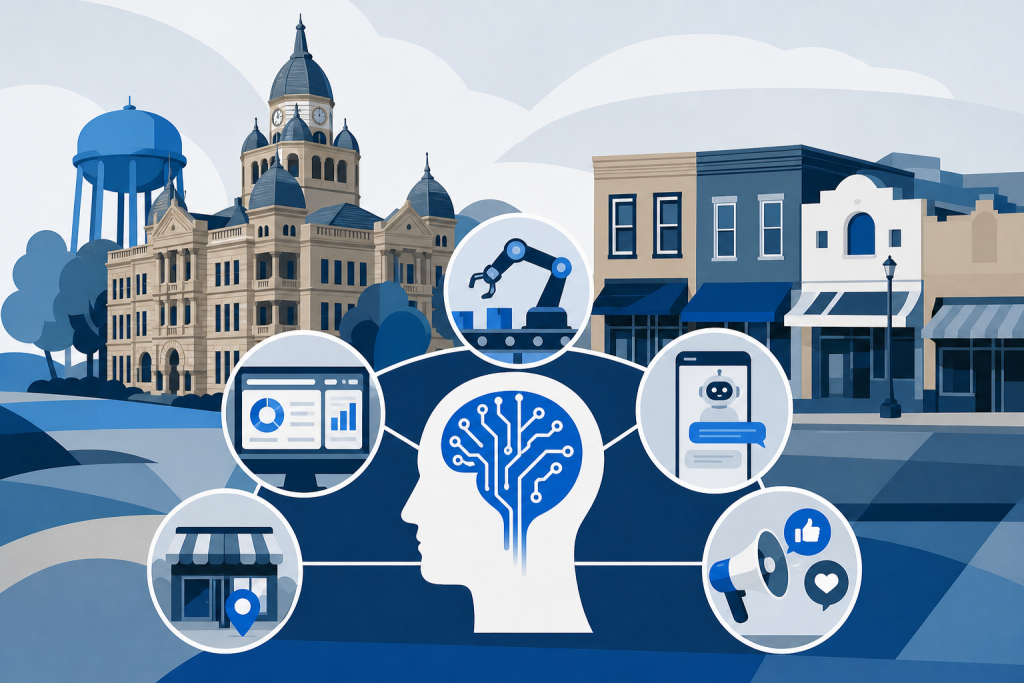
AI has gone from a curiosity to a daily tool inside Denton offices, shops, and clinics in less than three years. The shift is real, the numbers are unmistakable, and the businesses that delay are starting to feel the gap on response time, on margin, and on hiring.
This guide breaks down five concrete ways Denton owners are using AI services for businesses right now to cut hours, raise margins, and respond to customers faster. You will see what is working on the Square, along I-35, and in offices around UNT, with the data and the trade offs laid out clearly so you can pick your first move with confidence.
Key Takeaways
- 58 percent of US small businesses reported using generative AI in 2025, up from 23 percent just two years earlier.
- 86 percent of small businesses using AI say it has made their operations more efficient, not just experimental.
- Generative AI chatbots are the number 2 most used tech tool for small businesses at 44 percent adoption, behind only search engines.
- AI high performers are roughly 3 times more likely than peers to redesign workflows around AI and to see meaningful EBIT impact.
Why Denton Businesses Are Adopting AI Services Faster Than Ever
Denton blends college town demand around UNT and TWU with a steady base of small manufacturers off Loop 288, medical practices along University Drive, real estate brokerages, accounting firms, and service trades that all run lean. When a four person front office can produce the work of six with the right AI tools in place, owners pay attention, and they are paying attention now.
National data backs the trend at speed. 58 percent of US small businesses self identified as using generative AI in 2025, up from 40 percent in 2024 and 23 percent in 2023, one of the fastest documented technology adoption curves on record.
Confidence is climbing alongside usage. 80 percent of small business owners now believe AI will help their business as time progresses, a sharp jump from 60 percent the year before and a clear signal that AI is being viewed as a competitive tool rather than a novelty.
That confidence is not blind optimism. 86 percent of adopters report that AI has made their operations more efficient, which means most owners trying AI are seeing tangible productivity wins rather than running experiments that never pay off.
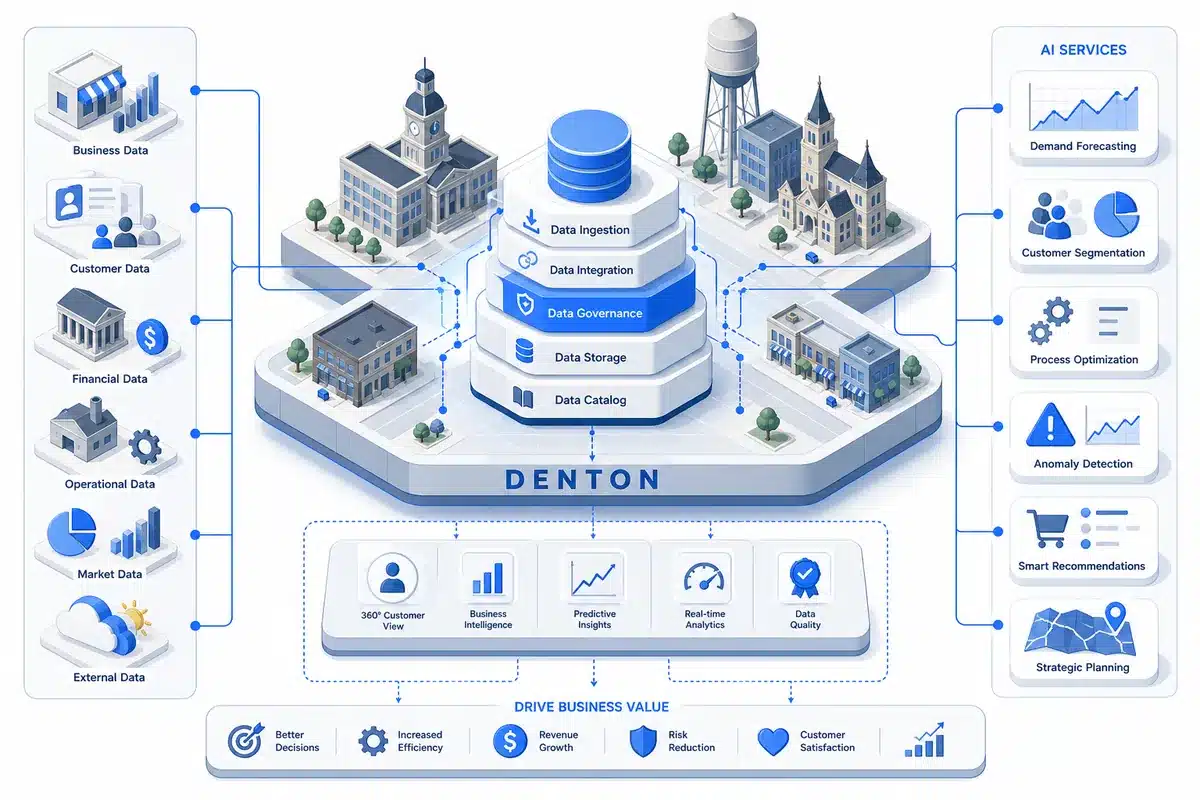
AI Adoption and Impact: Small Business Numbers That Matter in 2025
Sources: US Chamber of Commerce 2025 Small Business AI Survey, McKinsey State of AI 2024 to 2025.
Way 1: Customer Service Chatbots That Cover the After Hours Gap
Generative AI chatbots have climbed to the second most used tech tool among small businesses at 44 percent adoption, second only to search engines at 46 percent. A year earlier they sat in fifth place, so the move into the top tier has happened in roughly twelve months.
In Denton, a chiropractic clinic on University Drive, a plumbing company off Teasley Lane, or a real estate office near the Square can plug a chatbot into the website, Google Business Profile, and Facebook page to answer pricing, hours, parking, and booking questions overnight. Most owners we work with report that 30 to 50 percent of inbound questions are repeat asks the bot can handle without a human, which frees the front desk for the calls that actually need judgment.
The trick is scoping. A good AI services partner trains the bot on your real FAQs, intake forms, and pricing rules, then routes anything outside that scope to a real person the next morning with a clean ticket.
Way 2: Marketing Content and Local SEO at Half the Time
Writing weekly blog posts, social captions, holiday promos, and Google Business Profile updates used to consume a full day of staff time each week at a typical small business. AI drafting tools paired with a clear brand voice document and a local content calendar cut that to one or two hours, which moves marketing from an afterthought to a steady weekly rhythm.
Denton retailers, restaurants, and event venues are using AI to turn one event, a sidewalk sale on the Square or a tap takeover at a local brewery, into ten pieces of content spread across email, Instagram, TikTok, and a follow up blog post. The photos and the offers still come from the owner or team, the drafting, resizing, and scheduling come from AI in minutes instead of hours.
Local SEO benefits in the same way. AI tools that suggest schema, internal links, and FAQ blocks based on real Denton search queries help small sites compete with bigger Dallas and Fort Worth players without hiring a full agency.

Way 3: Back Office Automation for Scheduling, Invoicing, and Bookkeeping
Back office tasks are usually where AI pays back fastest. Auto matching receipts to QuickBooks transactions, drafting invoices straight from job notes, and reconciling card payments can save a Denton bookkeeper five to ten hours every week with no change to the underlying accounting system.
Scheduling is another quick win that owners feel within days. AI assistants can read inbound emails, propose meeting times that match your real calendar rules, and book directly into Google Calendar or Microsoft 365 without the back and forth that used to chew up a receptionist’s morning.
86 percent of small businesses say AI has helped their operations become more efficient, and back office automation is almost always the first place owners feel that gain. The hours come back as time for higher value work like client follow up, quoting, training, and the occasional long lunch the team has earned.
Way 4: Sales Intelligence and Lead Scoring for Tighter Pipelines
Denton B2B sellers, from IT shops on Loop 288 to commercial cleaners, HVAC contractors, and managed service providers, are using AI to score leads the moment they arrive. The model looks at company size, website signals, form fields, and even past close history, then flags which leads deserve the first call back and which can stay in a nurture sequence.
Sales reps spend roughly a third of their time on research and admin in most published surveys. AI summarizes LinkedIn profiles, recent company news, and prior email threads into a one paragraph briefing before each call, cutting that prep time in half and getting reps onto the phone earlier in the day.
The result is more dials, better matched offers, and shorter sales cycles overall. Owners who adopt this discipline report close rates rising 10 to 20 percent within a quarter once the CRM data is clean enough to feed the model.
Way 5: Operations, Inventory, and Demand Forecasting
Restaurants, retailers, and small manufacturers in Denton are using AI to predict demand by day of week, weather pattern, and UNT event schedule. A pizza shop near Fry Street can stock dough, prep the cold line, and staff the counter very differently for a home football Saturday than for a quiet Tuesday in July.
Inventory forecasting models also flag slow movers before they tie up cash on the shelf. That single change has freed five figures of working capital for small Denton retailers running on tight margins, money that often goes straight back into marketing or payroll.
For local manufacturers, predictive maintenance reads sensor data on CNC machines, conveyors, or HVAC compressors and warns of likely failures days in advance. The cost of one unplanned shutdown almost always dwarfs an entire year of AI monitoring subscription fees.
What Separates AI High Performers from Everyone Else
Only about 6 percent of organizations qualify as AI high performers in McKinsey’s most recent State of AI research. Those companies are roughly 3 times more likely than peers to redesign workflows around AI and to attribute meaningful EBIT impact to it, and the gap between leaders and laggards is widening every quarter.
The difference is not the tool, it is the workflow. High performers do not bolt a chatbot onto a broken intake process, they rebuild the intake process around what AI handles well and where humans still need to step in with judgment.
Talent strategy mirrors that same mindset. 71 percent of small business owners say hiring employees with AI skills will save them time in the long run, and 67 percent expect those hires will save them money as well.
How to Pick AI Services for Your Denton Business
Start with one bottleneck, not a platform purchase. The owners who get fastest results pick the single task that eats the most hours each week, often customer intake, quoting, or invoicing, and ship one well scoped AI assist for that task before they touch anything else.
Ask any AI services partner three questions before you sign a contract. Where does my data go, who owns the model outputs, and how will you measure success in the first 60 days with numbers I can verify.
Local presence matters more than most owners expect. A partner who can sit at your office near Rayzor Ranch or off Mayhill Road and watch your team work for an afternoon will spot waste and integration gaps that a remote vendor on a Zoom call will never see.
Common First Mistakes Denton Owners Make With AI
Mistake one is pasting customer information into a free consumer chatbot. Use the business or enterprise tier of any tool you adopt, confirm that the provider does not train on your data, and set up role based access from the very first day.
Mistake two is treating an AI project like a one time install. Models, prompts, and integrations need monthly review, the same way your antivirus, your books, and your phone system need a routine checkup to stay reliable.
Mistake three is skipping the measurement step entirely. If you cannot show hours saved, leads closed, or dollars recovered after 90 days, the project is drifting and needs a reset before it eats more of your subscription budget.
Frequently Asked Questions
What does AI services for businesses actually include in Denton?
AI services for businesses usually combine chatbots, content drafting tools, workflow automation, and analytics tuned to your specific industry and tech stack. A local Denton provider scopes the project, integrates with platforms you already use like Microsoft 365, QuickBooks, or your CRM, and trains your team on safe daily use so the value compounds over time.
How much does it cost to add AI to a small Denton business?
Entry level chatbots and AI content tools start around 50 to 200 dollars per month per seat or workflow. Custom integrations with your CRM, phone system, or industry specific software typically run a one time setup fee in the low thousands plus a monthly support charge that scales with usage and number of users.
Is my customer data safe when I use AI tools?
It can be, but only if the contract and configuration are set up correctly. Use business or enterprise tiers that promise not to train on your data, lock down role based access, and never paste customer personal information into a free consumer chatbot.
How fast will I see results from AI in my operations?
Most Denton owners feel a difference within 30 to 60 days on the first workflow, especially in customer response time and content output. Larger gains, like a measurable margin lift or a higher close rate, usually show up between months three and six as the team adapts and the underlying data improves.
Do I need to hire someone with AI skills or can I train current staff?
Most small Denton teams retrain current staff first because they already understand the customers and the workflows. 71 percent of small business owners say AI skilled hires save time and 67 percent say they save money, so plan to add at least one AI fluent role as you scale past the easy wins.
For a deeper look at how the technology itself works and what it can realistically do for a small operation, the agency’s overview of Artificial Intelligence (a.i.) lays out the fundamentals in plain language. Artificial Intelligence (a.i.).
For a closer look at the tactics behind each of these shifts, the full breakdown in 5 Ways Denton Businesses Are Using AI To Work Smarter walks through real examples drawn from local industries across the city.

About the author
Matt Forman - Owner & Chief Techie
Matt Forman is the Owner and Chief Techie at Local Circuit, a Denton, Texas-based managed service provider he leads in delivering small-business technology management and security. For over 15 years, his team has worked alongside small businesses, local municipalities, law firms, and first-responder agencies as their trusted IT partner.