

Phone service is one of those line items Fort Worth business owners only look at twice a year, but it quietly drives a lot of how your team sells, supports, and shows up for customers. The question that lands in our inbox most often is simple: what does a real business VoIP phone system actually cost in Fort Worth, and what should show up on the invoice each month?
TLC has spent years wiring phones, networks, and IT for North Texas businesses, and we routinely see quotes that look great on paper turn into surprise invoices once taxes, hardware, and add-ons stack up. This guide breaks down current Fort Worth VoIP pricing by tier, the hidden line items to watch for, and a worked example for a 20-seat office so you can sanity check any quote you receive.
Key Takeaways
- Basic Fort Worth business VoIP plans run roughly $20 to $30 per user each month, while mid-tier feature sets land between $25 and $50.
- Enterprise-grade platforms with contact center, analytics, and global routing can reach $100 to $150 per user per month.
- Switching from a traditional landline or legacy PBX to cloud VoIP typically trims monthly telecom spend by 40 to 60 percent for Fort Worth businesses.
- Plan on $3 to $8 per user per month in regulatory recovery, E911, and porting fees on top of the advertised seat price.
What Business VoIP Actually Costs in Fort Worth Today
Most Fort Worth small and mid-size businesses end up paying somewhere between $20 and $50 per user per month for cloud VoIP, with the exact rate driven by feature tier, contract term, and headcount. That single per-seat number is the cleanest way to compare offers because it folds calling, voicemail, mobile apps, and basic admin tools into one line.
The lowest published prices you see in ads usually leave out regulatory recovery, E911 surcharges, and any device payments, which together add another $3 to $8 per user each month. A realistic all-in number for a typical Fort Worth office is closer to $28 to $58 per seat once those line items are added back in.
Enterprise tiers with contact center features, advanced analytics, custom integrations, and stronger uptime guarantees push pricing to $100 to $150 per user per month. Those plans are common for larger Fort Worth deployments such as call centers, multi-clinic healthcare groups, and regional financial firms with strict compliance demands.
Pricing has held steady across 2025 and into 2026, with promotional discounts becoming more aggressive for new logos as competition has tightened in the DFW market. If your current contract is more than two years old, a fresh quote from two or three providers is almost certain to come in lower than your current bill.
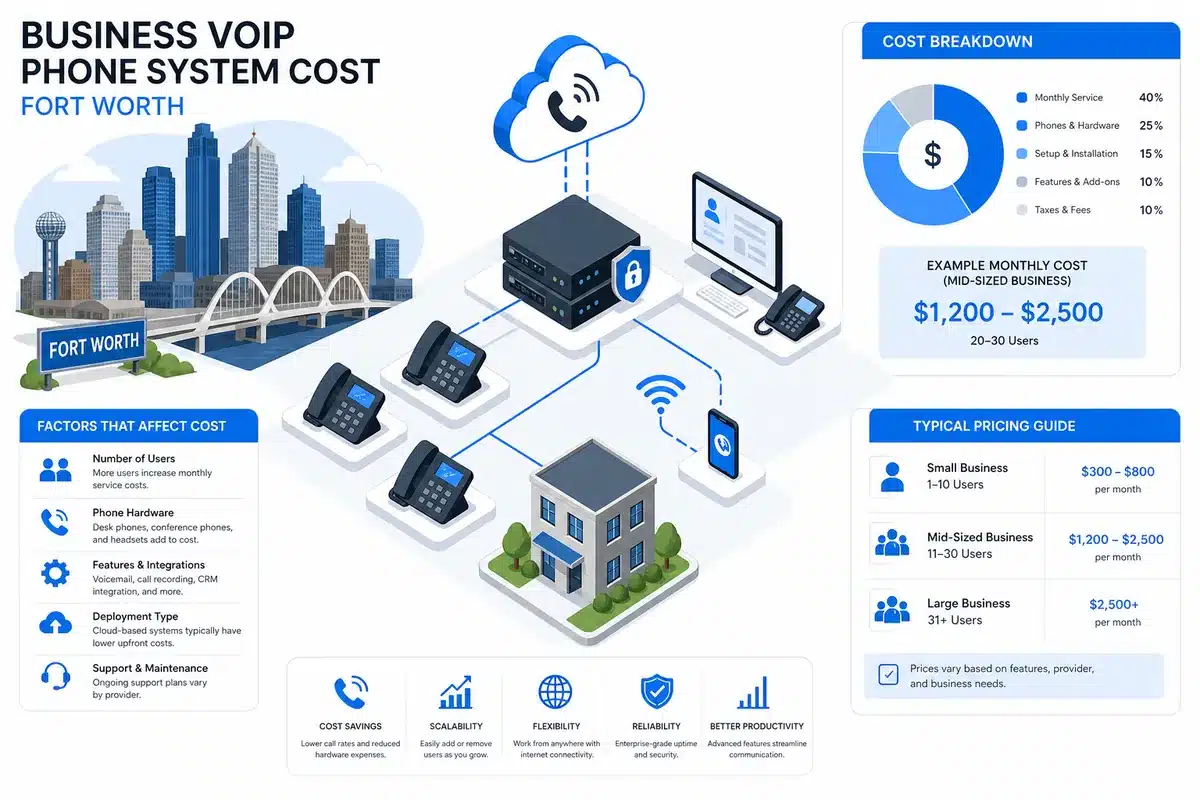
Fort Worth Business VoIP Pricing at a Glance (2026)
Ranges reflect 2025 to 2026 Fort Worth and DFW market pricing across major cloud VoIP providers and local resellers.
The Three Pricing Tiers Fort Worth SMBs Choose Between
The basic tier at $20 to $30 per user covers unlimited domestic calling, voicemail to email, a softphone app for mobile and desktop, and standard hunt groups or extensions. This tier suits small Fort Worth offices that mainly need reliable inbound and outbound calling without the bells and whistles.
Mid-range plans at $25 to $50 per user add the features most Fort Worth SMBs actually use day to day. Expect call recording, video conferencing, SMS, multi-level auto attendants, and CRM integration with tools like Salesforce, HubSpot, or Microsoft Dynamics included at this band.
Enterprise plans at $100 to $150 per user roll in omnichannel contact center features, real-time supervisor dashboards, workforce management add-ons, custom API integrations, and stronger uptime guarantees. These tiers are overkill for a 10-person office but a strong fit for a 200-seat Fort Worth operation that lives or dies by call metrics.
Hidden Fees That Show Up on a Fort Worth VoIP Invoice
The seat price is rarely the full bill, and Fort Worth buyers regularly tell us they were surprised by the fee stack on their first month’s invoice. Common line items include federal Universal Service Fund charges, state and local 911 fees, regulatory recovery fees, and carrier cost recovery surcharges.
Together, those add-ons typically tack on $3 to $8 per user per month above the advertised seat rate. On a 20-seat plan, that is $60 to $160 in extra monthly spend that any honest quote should call out clearly before you sign anything.
One-time fees usually appear at the start of service, including number porting (often $10 to $25 per number), professional installation, and onboarding or training time. Ask any prospective provider for a redacted sample invoice from a similar-sized Fort Worth client so you can see the true all-in cost before you commit.

VoIP vs. Traditional PBX: The Fort Worth Cost Comparison
A traditional on-premise PBX for a 20-user Fort Worth office typically requires $10,000 to $20,000 in upfront hardware before installation labor and ongoing maintenance contracts. The total only climbs once you add SIP trunks or PRI circuits, UPS protection, and a server closet with proper cooling and power.
By contrast, cloud VoIP shifts almost the entire spend into a predictable monthly seat charge with no capital expense. A 20-user Fort Worth office on a basic VoIP plan can land at roughly $400 per month, compared with $1,000 to $2,000 monthly on a traditional PBX once trunk lines and maintenance are included.
Most Fort Worth businesses save 40 to 60 percent on monthly telecom expenses after they switch from landlines or legacy PBX to a cloud platform. That savings figure is before counting the avoided capital expense on hardware refresh cycles every five to seven years.
Cloud VoIP also lets remote and hybrid teams work from anywhere with the same business number, which has become a hard requirement for many Fort Worth firms that hire across DFW. Legacy PBX cannot match that flexibility without expensive site-to-site VPNs or session border controllers added on top.
Hardware Costs: Desk Phones, Headsets, and Network Gear
Most cloud VoIP plans let you start with a softphone app on a laptop or smartphone, which keeps the day-one hardware cost at zero. Adding physical IP desk phones is optional but common for receptionists, executives, retail counters, and conference rooms across Fort Worth offices.
List prices for desktop IP phones range from about $80 for a basic two-line model to more than $700 for a touchscreen unit that supports Zoom or Microsoft Teams video. A typical Fort Worth office blends a couple of executive phones with mid-range models at $150 to $250 to keep total hardware spend in check.
Headsets and conference speakerphones round out the hardware list, with quality wireless headsets running $150 to $400 and conference room units between $200 and $1,200. Buy the headset your team will actually wear, because a good one pays for itself in clearer calls and less fatigue over a year of daily use.
Do not skip the network audit, because VoIP only sounds as good as the LAN behind it. Budget for a managed switch with PoE, a business-grade firewall with QoS rules, and enough symmetrical bandwidth to give each concurrent call about 100 kbps of headroom.
A Worked Example: 20-Seat Fort Worth Office on Mid-Tier VoIP
Picture a 20-person Fort Worth professional services firm that needs call recording, video meetings, and a Salesforce integration. A mid-tier plan at $35 per user lands the seat cost at $700 per month before fees.
Layer in $5 per user per month in regulatory recovery, E911, and Universal Service Fund charges, and the all-in monthly bill rises to about $800. Spread a one-time hardware order of fifteen $200 IP phones across 36 months and the effective monthly cost climbs by roughly $83.
Total monthly run rate for this firm lands at roughly $880 to $900 all-in. Against a traditional PBX quote of $1,400 to $1,800 per month plus a $15,000 upfront hardware bill, the VoIP path saves the firm meaningful money in year one and accelerates from there.
What Drives Your Fort Worth VoIP Quote Up or Down
Headcount, feature tier, and contract length are the three biggest levers on the seat price you will be quoted. Three-year agreements typically shave 10 to 20 percent off the per-user rate compared with a true month-to-month deal.
Industry compliance requirements such as HIPAA for Fort Worth medical offices or PCI for retail and hospitality often push you into a mid-tier or enterprise plan. International calling volume, contact center seats, and toll-free minute pools also stack onto the bill in ways the advertised seat price does not show.
Local factors matter too, including how many physical sites you have across Tarrant County and whether your buildings already carry business-grade internet. A Fort Worth office on residential cable is a sound quality problem waiting to happen no matter how strong the VoIP plan looks on paper.
Pay attention to the renewal price, not just the introductory rate, because providers often raise rack rates at renewal once the initial promo expires. Lock the renewal cap into the contract if you can, ideally with a no-more-than 3 to 5 percent annual escalator written in.
How to Compare Fort Worth VoIP Quotes Without Getting Burned
Ask every vendor for an apples to apples seat price at the same feature tier, plus a separate line showing taxes, regulatory fees, and any device costs. Request the contract length, auto-renewal language, and the early termination fee in writing before any signature.
Confirm what is included in support, including business-hours coverage, after-hours emergency response, and whether on-site help for a Fort Worth address is available without a per-visit charge. A provider that ships hardware and leaves you to plug it in is a different product than one that walks your team through cutover day.
Test the experience before you commit, either with a 30-day pilot for a small team or by calling the vendor’s published support number to see how quickly a human answers. The cheapest seat price is not a deal if every support ticket sits in queue for a day or two.
Frequently Asked Questions
How much does business VoIP cost in Fort Worth for a 10-person office?
For a 10-person Fort Worth office on a mid-tier plan, expect roughly $350 to $500 per month all-in, including taxes, E911, and regulatory recovery fees. That assumes a $30 to $40 per user seat price and modest hardware costs spread across the contract term.
Is there a setup or installation fee for Fort Worth VoIP?
Most cloud VoIP providers charge a one-time fee for porting your existing numbers, with porting itself usually running $10 to $25 per number. Professional installation and onboarding are sometimes bundled, but training and on-site cutover help can add $500 to $2,000 for a typical small Fort Worth office.
Will VoIP save my Fort Worth business money compared with a landline?
In most cases yes, with Fort Worth businesses commonly cutting 40 to 60 percent off their monthly telecom spend after switching to cloud VoIP. You also avoid the capital expense of replacing PBX hardware on a five to seven year cycle, which can run $10,000 to $20,000 for a 20-user office.
Do I need new internet service for VoIP to work well in Fort Worth?
Not always, but you do need business-grade internet with enough symmetrical bandwidth and a router or firewall that supports QoS. A fiber or business cable connection from Spectrum, AT&T, or Frontier with at least 100 kbps reserved per concurrent call usually keeps quality strong.
Can I keep my current Fort Worth phone numbers when switching to VoIP?
Yes, number porting from any current carrier is standard and most providers handle the paperwork on your behalf. The process typically takes 7 to 21 business days, during which both the old and new services remain active to prevent any downtime.
For a deeper look at the physical handsets and software clients that connect to your cloud platform, our guide to VoIP Telephones covers the full range of options available to Fort Worth businesses.
For a deeper look at the numbers behind each tier, How Much Does A Business VoIP Phone System Cost In Fort Worth? walks through the full breakdown with current market data. How Much Does A Business VoIP Phone System Cost In Fort Worth?.
If you want a deeper look at the underlying economics before committing to a platform, the full breakdown in VoIP Vs Landline For Dallas Businesses covers how each system stacks up on total cost, flexibility, and long-term value for North Texas companies.

About the author
Matt Forman - Owner & Chief Techie
Matt Forman is the Owner and Chief Techie at Local Circuit, a Denton, Texas-based managed service provider he leads in delivering small-business technology management and security. For over 15 years, his team has worked alongside small businesses, local municipalities, law firms, and first-responder agencies as their trusted IT partner.