

Phone bills, dropped calls, and a closet full of aging PBX hardware are pushing Denton businesses to look hard at hosted VoIP. The numbers driving that shift are not abstract, with businesses usually saving 30 to 50 percent on phone costs after the switch.
TLC has helped offices across Denton County move from legacy phone systems to cloud based voice, and the pattern is consistent. Lower bills, fewer service calls, and remote ready features that legacy lines simply cannot match are the three reasons we hear most often.
Key Takeaways
- Hosted VoIP commonly cuts monthly phone bills by 30 to 50 percent for Denton small and mid sized businesses.
- Cloud PBX removes the upfront hardware bill that legacy systems require, often lowering startup costs by up to 90 percent.
- UCaaS features like voicemail to email, mobile apps, and auto attendants recover about 30 minutes per employee per day.
- Real savings show up at the per employee level, with hosted VoIP averaging roughly 1,200 dollars in annual savings per seat.
Why Denton Businesses Are Moving Off Legacy Phones
Denton is full of small medical practices, real estate offices, retail shops near the Square, and a growing wave of tech firms around UNT and TWU. All of them depend on a phone system that just works, and most are finding that aging copper or older on premises PBX hardware cannot keep up with how they actually do business today.
The catalysts are almost always the same, with a price hike from the legacy carrier, a hardware failure on the PBX, or a hiring round that adds three more employees who need extensions tomorrow. When that moment hits, hosted VoIP is consistently cheaper, faster to deploy, and easier to scale than a like for like landline replacement.
National adoption numbers back the local trend. More than 60 percent of US companies have already migrated from traditional telephony to VoIP or cloud communications, and 85 percent of small and medium sized businesses will prioritize hosted deployments by 2025.
Customer expectations are the other major push, since callers expect a fast answer, an easy transfer, and a voicemail they can actually retrieve from anywhere. Hosted VoIP makes all three of those a default behavior instead of a paid add on, which is why so many Denton owners describe the switch as overdue rather than experimental.
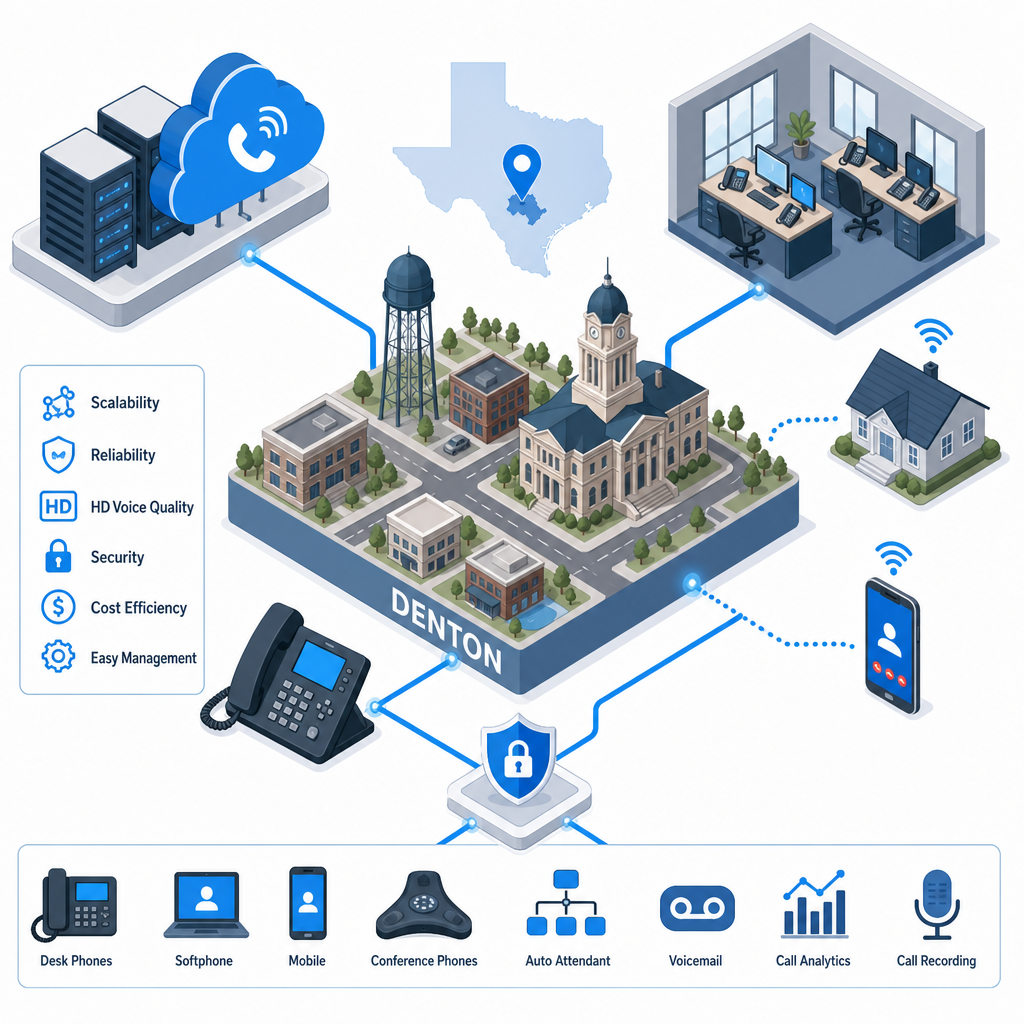
Hosted VoIP vs Legacy Phones: What Denton Businesses Can Expect
Sources: Nextiva 2025 VoIP statistics, NUACOM 2025 VoIP report, Mordor Intelligence SMB cloud communications forecast, TLC project data.
What Hosted VoIP Actually Is (and How It Differs From Legacy PBX)
Hosted voice service refers to telephone services across your internet connection, and it depends on a virtual private branch exchange (PBX) to handle incoming and outgoing connections. The phone system itself, meaning the call routing brain, lives in your provider’s data center rather than a metal box bolted to the wall of your server closet.
A traditional PBX in Denton typically meant a several thousand dollar piece of hardware, a separate maintenance contract, and a slow change order any time you added a user or wanted a new feature. Hosted VoIP collapses those line items into a single per seat monthly fee that covers the platform, the features, the firmware updates, and the support.
From the user’s seat, the experience is very similar to a familiar desk phone, with dial tones, three digit extensions, hold music, and transfers all working the way staff expect. The difference shows up behind the scenes, where adding a new hire, a softphone, or a remote office takes minutes inside a web portal instead of a service ticket to a vendor.
There are two common deployment flavors worth knowing, with pure cloud PBX hosting everything off site, and hybrid setups that keep a local appliance for survivability on top of cloud features. Most Denton small and mid sized businesses do best with pure cloud, while larger multi site operators sometimes benefit from the hybrid model.
The Real Cost Story for Denton Offices
The most cited number in the industry is a 30 to 50 percent reduction in monthly phone spend, and that range tracks closely with what we see across Denton accounts. A 12 person office paying around 900 dollars a month for analog lines and a maintenance plan typically lands closer to 450 to 600 dollars after the cut over.
Startup costs are where the gap gets dramatic, especially for new Denton businesses opening a first office or a second location. New businesses can reduce their initial communication costs by up to 90 percent by choosing VoIP instead of traditional hardware based phone systems, since the on premises PBX, structured voice cabling, and per port licensing fees all drop off the budget.
Annual savings tend to land near 1,200 dollars per employee once you add up the avoided bills, retired hardware, and reduced IT time. Companies save an average of 1,200 dollars per employee annually thanks to reduced phone bills and lower infrastructure costs, which works out to roughly 30,000 dollars a year for a 25 person Denton firm.
There are still real costs to plan for, including quality handsets, headsets for hybrid staff, and a properly sized internet circuit with QoS configured. Even after accounting for those, the three year total cost of ownership in our project files is consistently 40 to 60 percent below the equivalent legacy build, which is what makes the ROI conversation short.

Features Denton Businesses Actually Use
Voicemail to email is the feature staff name first, because it turns a missed call into a searchable inbox item that can be forwarded, replied to, or tagged in a CRM. Auto attendants follow close behind, routing callers to the right department without tying up a receptionist on every transfer.
Mobile apps and softphones let an agent at a Denton real estate firm answer the office line from a showing, or a clinic nurse return calls during charting time without giving out a personal cell number. Calls show the business caller ID instead of the staffer’s mobile, which keeps boundaries clean and the brand consistent.
Call recording, hunt groups, call queues, and integrations with CRM tools round out the standard feature set on most hosted plans. Most of these were premium add ons on a legacy PBX, and they now ship as table stakes with modern cloud platforms at no extra cost per seat.
For larger Denton offices, AI receptionists and conversational voice bots are starting to handle routine intake calls like appointment confirmations, hours questions, and basic triage. That is not future hype, it is already in production at several offices we support across Denton County.
How Hosted VoIP Fits Different Denton Industries
Medical and dental offices in Denton lean on hosted VoIP for call queues, voicemail to email, and direct routing to specific specialists or front desk staff. HIPAA covered providers pair the platform with a signed Business Associate Agreement and encrypted call paths, which keeps patient communications compliant without slowing down scheduling work.
Professional services firms, like the accounting practices and law offices clustered around downtown Denton, use hosted VoIP for call recording, multi line ringing, and CRM integration so client conversations are logged automatically. The mobile app keeps after hours availability practical without giving out personal cell numbers to every client.
Restaurants, salons, and retail shops near the Square want consistent greetings across locations, simple hold music, and a fast way to handle reservation or appointment calls during a rush. Hosted platforms standardize all three, which keeps brand voice consistent during busy hours and across multiple Denton storefronts.
Real estate firms, contractors, and field service teams rely heavily on the softphone and mobile app pieces of hosted VoIP to stay reachable while away from a desk. Calls follow the agent through showings, site visits, and job walks, and missed calls drop straight into a voicemail inbox the team can search later that day.
Remote, Hybrid, and Multi Location Work
A surprising number of Denton businesses now have at least one fully remote role, plus a few hybrid staff who split time between the office and home each week. Hosted VoIP treats that distributed team like a single phone system, with extensions ringing wherever the user happens to be working that day.
For multi location operators, like a dental group with offices in Denton, Argyle, and Flower Mound, a single hosted PBX replaces three separate phone bills and three different voicemail systems. Calls route between locations as internal extensions, and a consistent auto attendant greets every caller regardless of which office they dialed.
Recovered productivity adds up faster than most owners expect. Implementing UCaaS saves employees an average of 30 minutes per day by centralizing communication and streamlining workflows, which usually shows up first in faster customer callbacks and shorter internal email threads.
Hybrid scheduling also benefits from presence indicators, which show whether a colleague is on a call, in a meeting, or free to take a quick question. Front desk staff in Denton offices use that view to give callers a real answer about availability instead of guessing and dropping them into voicemail.
What to Look For in a Denton Hosted VoIP Provider
A good Denton hosted VoIP provider should map your call flow to how the office actually works, not push a generic auto attendant template lifted from a template library. Front desk, sales, service, after hours, and remote staff each need their own routing logic, and a discovery call should cover all five.
Ask about bundling managed IT with managed VoIP, because most call quality issues are network issues at heart. When one team owns the phones, the firewall, and the LAN, finger pointing between vendors goes away and tickets close faster.
Confirm number porting timelines, training plans, and how the provider handles after hours support before you sign anything. A Denton business that loses its main number for two days during a port is going to feel it in revenue, so the porting plan matters as much as the price sheet.
Service level agreements, uptime targets, and the contractual response window for outages are the last items to nail down. Leading VoIP providers guarantee an uptime of 99.99 percent, ensuring businesses experience minimal disruptions in communication, and any reputable provider should put that commitment in writing
.
Common Mistakes When Switching to Hosted VoIP
The single most common mistake is ignoring the internet circuit during planning. Hosted VoIP rides on your connection, so a flaky cable modem, a saturated DSL line, or a misconfigured router will produce choppy audio no matter how good the platform is on the back end.
The second mistake is buying too many or too few features per seat across the company. A retail counter does not need the same plan as a sales floor or an outbound call center, and good providers offer mixed seat types so you can right size the spend by role.
The third is skipping training during the cut over week. Hosted VoIP only delivers its full ROI when staff actually use voicemail to email, the mobile app, transfers, and call queues, and that takes a short, structured onboarding session rather than a PDF emailed to the team.
The fourth is treating the legacy phone number port as an afterthought. Numbers should be ported on a confirmed date with the new platform fully tested in parallel, so the cut over is a checklist instead of a fire drill on Monday morning.
Frequently Asked Questions
How long does it take to switch a Denton business to hosted VoIP?
Most small offices in Denton are fully cut over within 2 to 4 weeks, with the bulk of that time spent waiting on number porting from the legacy carrier. The actual on site install of handsets and softphones usually takes a single afternoon once the numbers move.
We typically run the new platform in parallel for a few days before flipping the port, so the cut over is a checklist rather than a fire drill.
Will our phones still work if the internet goes down?
A pure hosted setup needs internet for calls to ride on, so a complete office outage will affect the desk phones at that location. Most modern plans include automatic failover to mobile numbers or softphone apps that connect over LTE, which keeps the business reachable while the circuit is repaired.
For mission critical offices, we usually pair a primary fiber line with a 5G or cable backup that the firewall can switch to automatically.
Do we have to buy new phones to switch?
Some legacy IP handsets can be reprovisioned to a new platform, but most Denton offices use the move as a chance to refresh their hardware after years of service. Modern IP phones typically run 100 to 250 dollars per unit depending on the model and feature set.
Plenty of staff are also happy with a softphone on their computer paired with a quality USB headset, especially in hybrid roles.
Can we keep our existing Denton phone numbers?
Yes, local number portability is a standard part of any switch, and a good provider will handle the LNP paperwork with your old carrier on your behalf. Plan on a porting window of 5 to 15 business days from the day the losing carrier signs off, and avoid canceling the old service until the port is confirmed complete.
Toll free numbers port the same way and on roughly the same timeline.
Is hosted VoIP secure enough for a medical or financial office?
Reputable hosted VoIP platforms encrypt call traffic in transit using SRTP and TLS, and they run inside SOC 2 audited data centers with redundant power and connectivity. Pair that with a managed firewall, VLAN segmentation between voice and data, and current handset firmware, and the security posture meets the standards most regulated Denton offices require.
For HIPAA covered practices, providers will sign a Business Associate Agreement as part of onboarding.
How much does hosted VoIP cost per user in Denton?
Most Denton businesses pay between 20 and 35 dollars per user per month for a full featured hosted plan that includes unlimited calling in the US and Canada. AI receptionist features, contact center add ons, and international calling can push the per seat price higher, but a standard small business seat lands in that 20 to 35 dollar range.
Annual contracts usually shave another 15 to 25 percent off the monthly rate.
The handsets and headsets that make up your office’s Voip Telephones are a key part of getting the most from a hosted deployment, and choosing the right hardware ensures call quality matches the platform’s capabilities.
Businesses weighing the transition often start with a side-by-side breakdown, and our guide on VoIP vs Landline for Dallas Businesses covers the cost, reliability, and feature differences in detail for companies across the broader DFW market.
If you’re not sure whether a move is overdue, the guide on 7 Signs Your North Texas Business Has Outgrown Its Phone System walks through the most telling warning flags in plain terms.